gaze-laravel maintained by thewonderjoy
thewonderjoy/gaze-laravel
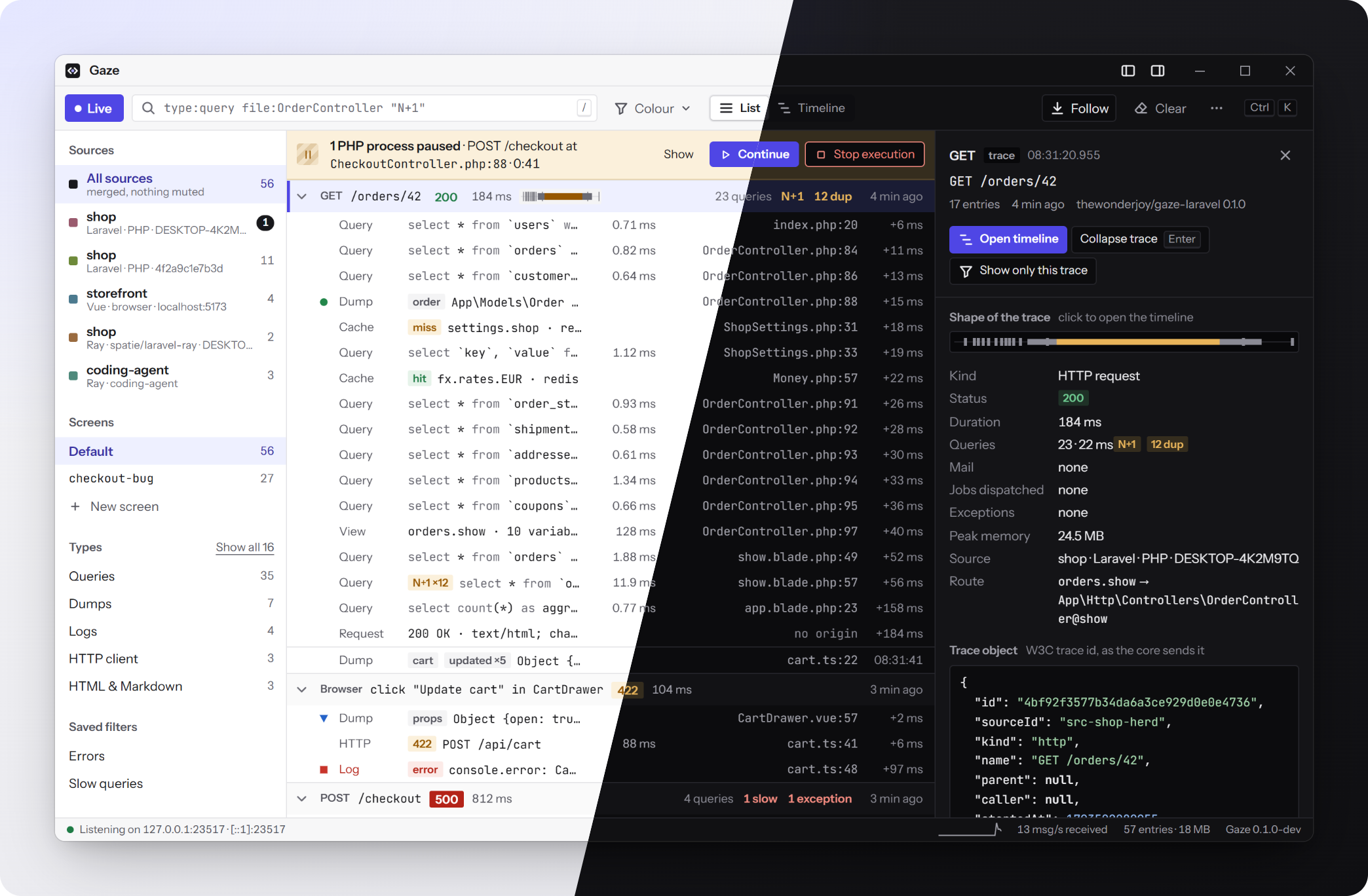
See what your Laravel app is doing in the Gaze desktop app. You get your own gaze() calls plus queries, logs, exceptions, mails, jobs and more, grouped by the request, job, command or test they came from.
Gaze is a desktop debug window for PHP, Laravel and JavaScript apps, on Mac, Windows and Linux. This package builds on thewonderjoy/gaze-php.
Get the app: download Gaze from thewonderjoy.com/products/gaze.
Install
composer require thewonderjoy/gaze-laravel
It needs PHP 8.2+ and Laravel 12 or 13. Laravel finds the service provider by itself. Open the Gaze app, then check that your app can reach it:
php artisan gaze:doctor
If it can't, for example under Sail, Docker or WSL, or because Gaze runs on another port, the command prints the .env lines to add. To change settings, publish the config with php artisan vendor:publish --tag=gaze-config.
Normal or --dev?
Install it as a normal dependency, as above. --dev keeps the package off your servers, but then a call you forgot to remove breaks there:
composer require |
composer require --dev |
|
|---|---|---|
| In production | Installed but off. Only its service provider and a no-op load, and nothing is registered or sent. | Not installed (composer install --no-dev) |
A gaze() or gaze_dd() you forgot |
Does nothing. gaze_dd() doesn't exit. |
Fatal error: Call to undefined function gaze() |
A ->gaze() you forgot on a collection, string or query |
Does nothing | BadMethodCallException |
A @gaze you forgot in a view |
Renders nothing | Shows up as @gaze(...) text on the page |
| Before you deploy | Nothing to do | Run php artisan gaze:clean to remove gaze() and gaze_dd() calls. Remove ->gaze() and @gaze by hand. |
Environments
Gaze is off when APP_ENV=production and on everywhere else, staging and testing included. Set GAZE_ENABLED=false on servers where you don't want it. To use it in production for a while, set GAZE_ENABLED=true.
Use
gaze('Hello', $user);                       // everything from gaze-php works
gaze()->model($order)->green();             // an Eloquent model with its relations
gaze()->mailable(new OrderShipped($order)); // a rendered mail
gaze()->showQueries();                      // show queries from here on
$total = gaze()->countQueries(fn () => $report->build());

collect($rows)->gaze('rows')->map(...);     // on collections, strings, query builders
User::where('active', true)->gaze()->get(); // the SQL with bindings, before it runs
$this->get('/orders')->gaze()->assertOk();  // on test responses
@gaze($order)
@gazeAll        {{-- every variable in this view --}}
@gazeMeasure    {{-- stopwatch --}}
Methods
gaze() has every method of gaze-php: values, colours, tables, pause(), measure(), count(), screens and the rest. This package adds the Laravel ones below.
Laravel values
| Method | What it shows |
|---|---|
model(...$models) |
Eloquent models with their attributes and loaded relations, one entry per model. Collections are flattened. |
models($collection) |
The same, for a collection. |
mailable(...$mailables) |
The rendered mail with subject, from, to, cc and bcc. |
view($view) |
A view's name, path and data. |
context(...$keys) |
Laravel Context data: all of it, or the keys you name. |
hiddenContext(...$keys) |
Hidden Context data. |
env($only = null, $file = null) |
The .env file as a table, with secrets masked. |
testResponse($response) |
A test response: status, headers, body and decoded JSON. |
countQueries(fn () => ...) |
Runs the closure, shows how many queries it ran and how long they took, and returns its result. |
Turn a watcher on for part of your code
Each watcher in the list below has three methods. With queries as the example:
| Method | What it does |
|---|---|
showQueries() |
Turns the watcher on from here. It returns an object you can style: gaze()->showQueries()->red(). |
showQueries(fn () => ...) |
Turns it on only while the closure runs, and returns the closure's result. |
stopShowingQueries() |
Turns it off. |
| Watcher | Sends |
|---|---|
Queries |
every query |
DuplicateQueries, SlowQueries($ms) |
only repeated queries, or only queries that take $ms or longer (default GAZE_SLOW_QUERY_MS, 500) |
SelectQueries, InsertQueries, UpdateQueries, DeleteQueries |
only that type of query |
Events, Exceptions, Jobs, Cache, Views, Mails, Dumps, Logs, Deprecations |
that watcher's entries |
Requests, HttpClientRequests |
incoming request details, or outgoing HTTP calls |
Short forms: queries(), slowQueries(), events(), jobs(), views(), requests(), httpClientRequests().
To send only some queries, pass a condition: showConditionalQueries(fn (QueryExecuted $query) => ..., $callback = null, $name = 'default'). Stop it with stopShowingConditionalQueries($name).
On other objects
| Call | Sends |
|---|---|
collect($rows)->gaze($label = '') |
the collection's items |
str($text)->gaze($label = '') |
the string |
User::where(...)->gaze($label = '') |
the SQL with bindings, before it runs |
$this->get('/')->gaze() |
the test response, as testResponse() does |
Each one returns the object you called it on, so you can keep chaining.
Blade
| Directive | Sends |
|---|---|
@gaze($a, $b) |
the values |
@gazeAll |
every variable in the view |
@gazeMeasure, @gazeMeasure('name') |
a stopwatch, like measure() |
Traces
Everything that happens during one request ends up together in the app, closed by a summary with the status, time, memory, query count and any N+1 warnings. Queued jobs, artisan commands and tests work the same way, and a job shows which request dispatched it.
A request sent from the browser links back to the call that sent it, so its trace shows from browser POST /api/cart. Gaze reads the W3C traceparent header for this, which gaze-js adds to the page's fetch and XHR calls once its network capture is on. There's nothing to set up on the Laravel side. To turn it off, set traces.accept_traceparent to false in config/gaze.php.
To get one trace per test, add the trait to your base test case:
use TheWonderJoy\Gaze\Laravel\Testing\TracesTests;

abstract class TestCase extends BaseTestCase
{
    use TracesTests;
}
Watchers
You can switch each watcher in config/gaze.php, with an env variable, or for part of your code with gaze()->showX().
| Watcher | Env | Default | Sends |
|---|---|---|---|
| exceptions | GAZE_EXCEPTIONS |
on | reported exceptions, with code snippets and the last queries |
| logs | GAZE_LOGS |
on | log messages, errors in red and warnings in orange |
| mails | GAZE_MAILS |
on | sent mails, rendered |
| dumps | GAZE_DUMPS |
on | dump() and dd() output |
| queries | GAZE_QUERIES |
on | SQL with bindings and time, flagging duplicates, slow queries and N+1 |
| jobs | GAZE_JOBS |
off | queued and processed jobs |
| events | GAZE_EVENTS |
off | dispatched events |
| views | GAZE_VIEWS |
off | rendered views and their data |
| cache | GAZE_CACHE |
off | hits, misses, writes, deletes |
| requests | GAZE_REQUESTS |
off | headers, payload and session, on the request summary |
| http_client | GAZE_HTTP_CLIENT |
off | outgoing HTTP calls with status and time |
| deprecations | GAZE_DEPRECATIONS |
off | PHP deprecation notices |
When the same query runs again and again (N+1), the app folds the runs into one row that lists each of them. A watcher that is off registers nothing, so it costs nothing.
The query switches add up: a query is sent when any of them matches it. queries sends every query, so while it's on, the switches below change nothing. GAZE_INSERT_QUERIES=false doesn't hide inserts. To see only some queries, turn queries off and switch on the ones you want:
| Env | Sends |
|---|---|
GAZE_DUPLICATE_QUERIES |
a query that already ran with the same bindings in this request |
GAZE_SLOW_QUERIES |
queries that take GAZE_SLOW_QUERY_MS or longer (default 500) |
GAZE_SELECT_QUERIES, GAZE_INSERT_QUERIES, GAZE_UPDATE_QUERIES, GAZE_DELETE_QUERIES |
that kind of statement |
For example, GAZE_QUERIES=false with GAZE_SLOW_QUERIES=true sends only slow queries. Request summaries still count every query while any query switch is on, but N+1 detection only sees the queries that are sent. With every query switch off, request summaries show no query count and exceptions don't list the last queries.
Secrets are masked
Before anything leaves your app, Gaze masks passwords, tokens, cookies, Authorization headers and .env secrets (*_KEY, *_SECRET, *_PASSWORD, *_TOKEN). This is on by default. See redact in the config.
Settings
| Key | Env | Default |
|---|---|---|
enabled |
GAZE_ENABLED |
on everywhere except production |
host |
GAZE_HOST |
found automatically: 127.0.0.1, the Docker or Sail host, the WSL2 host |
port |
GAZE_PORT |
23517 |
project |
GAZE_PROJECT |
APP_NAME |
config/gaze.php works with php artisan config:cache.
Artisan commands
php artisan gaze:doctorshows where PHP runs (Windows, WSL2, Docker, Sail), whether Gaze is on and why, which hosts answer, and the exact.envlines to add.php artisan gaze:clean [--dry-run]removesgaze()andgaze_dd()calls fromapp,routes,config,resources,testsanddatabase.
Ray compatibility
You can keep spatie/laravel-ray installed next to this package, because the Gaze app also accepts Ray's messages. To move over, replace ray( with gaze(. The method names are the same, apart from these:
| laravel-ray | Gaze |
|---|---|
collect()->ray(), str()->ray(), $query->ray(), $response->ray() |
->gaze() |
@ray, @xray, @measure |
@gaze, @gazeAll, @gazeMeasure |
ray($model), ray($mailable) |
gaze()->model($model), gaze()->mailable($mail). Plain gaze($model) shows an object dump, not the model view. |
php artisan ray:publish-config |
php artisan vendor:publish --tag=gaze-config |
php artisan ray:clean |
php artisan gaze:clean |
loggedMail() |
not yet |
| query watching is off by default | on by default, because traces and N+1 detection need it |
The gaze-php README lists the Ray methods it doesn't have.
If you'd rather not rename your calls, remove laravel-ray and set GAZE_DEFINE_RAY_HELPER=true (define_ray_helper in the config). Your ray() calls then go to Gaze. A call to one of the missing methods throws an error.
RAY_HOST and RAY_PORT are read when GAZE_HOST and GAZE_PORT aren't set.
License
MIT