laravel-lgpd-dsar maintained by jeffersongoncalves
Description
LGPD data subject requests (art. 18) for Laravel: request tracking with legal deadlines, identity verification, data export and erasure across your models.
Author
Last update
2026/11/16 20:50
(dev-main)
License
Downloads
0
Tags
Laravel LGPD DSAR
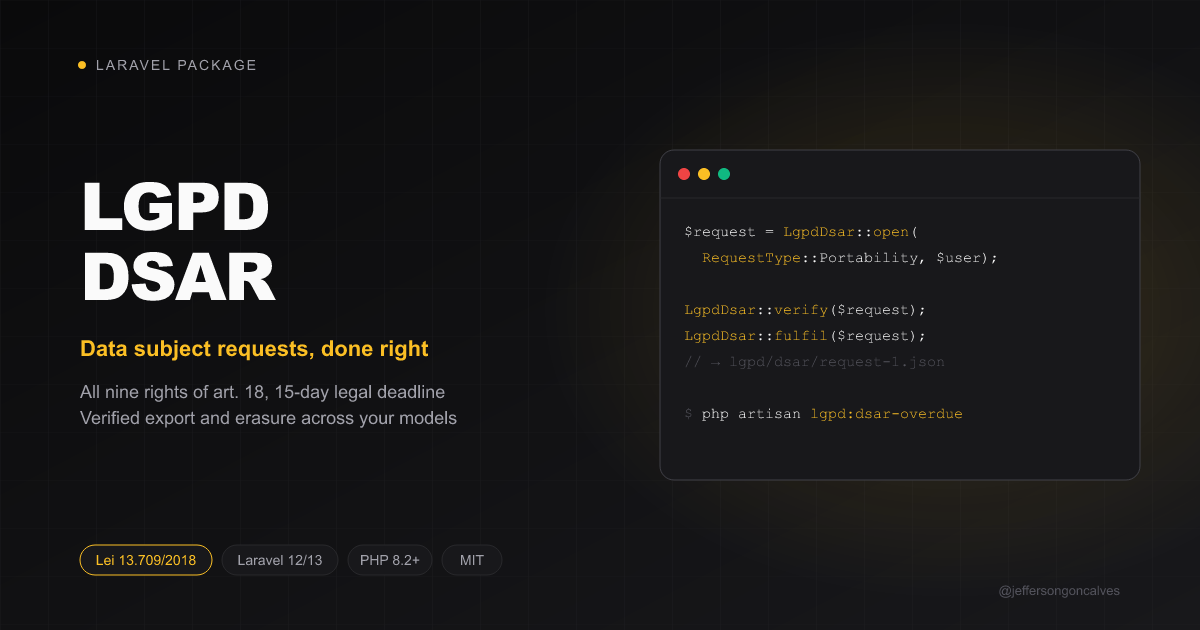



Handles data subject requests under the Brazilian General Data Protection Law (LGPD, Lei 13.709/2018, art. 18), using the data you declared with laravel-lgpd:
- tracks each request: its type (all nine rights of art. 18, I–IX), status, and the legal deadline (15 days by default, art. 19, II);
- requires an identity check before any export or erasure;
- exports every piece of personal data of the subject, from all your models, as JSON on a private disk (access and portability);
- erases the subject's data by applying each column's anonymize strategy. Columns marked
Keepare left untouched (legal retention, art. 16); - fires an event for every request past its deadline, so you can alert your DPO (encarregado).
This package gives you tooling. It does not make you compliant on its own. You still need legal review, for example to decide which requests you can reject and why.
Installation
composer require jeffersongoncalves/laravel-lgpd-dsar
php artisan vendor:publish --tag="lgpd-dsar-migrations"
php artisan migrate
php artisan vendor:publish --tag="lgpd-dsar-config"
Locating a subject's data
Models listed in lgpd.models (see laravel-lgpd) are searched for the subject's records:
- the subject's own model (e.g.
User) is found without extra code; - every other model says how to find the records that belong to a subject:
use JeffersonGoncalves\LgpdDsar\Contracts\ResolvesDataSubject;

class Order extends Model implements HasPersonalData, ResolvesDataSubject
{
    use InteractsWithPersonalData;

    public static function dataSubjectQuery(Model $subject): Builder
    {
        return static::query()->where('user_id', $subject->getKey());
    }
}
A model that does not implement ResolvesDataSubject is skipped.
Usage
use JeffersonGoncalves\LgpdDsar\Enums\RequestType;
use JeffersonGoncalves\LgpdDsar\Facades\LgpdDsar;

// 1. Open: from a logged-in user, or from a contact form (subject unknown yet)
$request = LgpdDsar::open(RequestType::Portability, $user);
$request = LgpdDsar::open(RequestType::Deletion, requester: ['name' => 'Maria', 'email' => 'maria@example.com']);

// 2. Verify the requester's identity, linking the subject if needed
LgpdDsar::verify($request, $user);

// 3a. Access / portability / anonymization / deletion run automatically
LgpdDsar::fulfil($request, 'Your data is attached.');
$request->export_path; // lgpd/dsar/request-1.json on the configured disk

// 3b. Other rights (confirmation, correction, sharing, consent info/revocation): handle them yourself, then:
LgpdDsar::complete($request, 'Your address was corrected.');
LgpdDsar::reject($request, 'Data kept to meet a legal obligation (art. 16, I).');
Lower-level helpers: LgpdDsar::export($user), LgpdDsar::exportToFile($user, 'file.json'), LgpdDsar::erase($user). erase runs inside a transaction.
Events
| Event | When |
|---|---|
DataSubjectRequestOpened |
a request is opened. Use it to confirm receipt to the requester |
DataSubjectRequestClosed |
a request is completed or rejected. Use it to notify the requester, sending the export as needed |
DataSubjectRequestOverdue |
lgpd:dsar-overdue found an open request past its deadline |
Schedule the deadline check:
Schedule::command('lgpd:dsar-overdue')->daily();
Testing
composer test
Changelog
See CHANGELOG.
License
The MIT License (MIT). See License File.