laravel-markdown-for-agents maintained by jeffersongoncalves
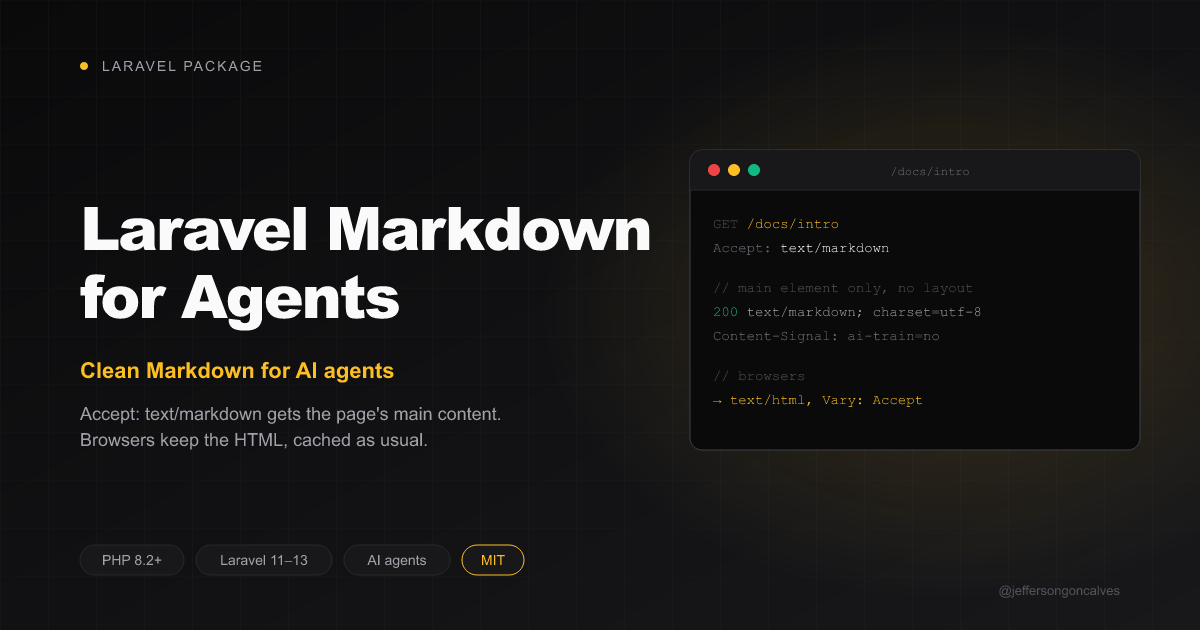
Laravel Markdown for Agents





Serve clean Markdown to AI agents. A request with Accept: text/markdown gets the page's main content converted to Markdown, instead of a dense HTML layout the agent has to scrape. Browsers keep getting HTML.
It is an origin-side equivalent of Cloudflare's Markdown for Agents, which only runs on Pro zones and above.
- Only the page's
<main>element is converted (configurable), so the navigation, header and footer stay out. Falls back to<body>. <script>,<style>,<svg>, forms,<nav>,<footer>... are dropped (configurable).- YAML front matter with the page
<title>and URL. - Optional
Content-Signalheader (contentsignals.org) to declare your AI preferences, e.g.ai-train=no. - Every HTML response gets
Vary: Accept, so HTTP caches keep the two representations apart. - Only
GET200text/htmlresponses are converted. JSON, redirects, errors and excluded paths pass through untouched.
GET /docs/intro HTTP/1.1
Accept: text/markdown

HTTP/1.1 200 OK
Content-Type: text/markdown; charset=utf-8
Vary: Accept
Content-Signal: search=yes, ai-input=yes, ai-train=no

---
title: "Introduction — My Docs"
url: https://example.com/docs/intro
---

# Introduction

Install the package with [Composer](https://getcomposer.org)...
Installation
composer require jeffersongoncalves/laravel-markdown-for-agents
Register the middleware as the outermost middleware of the web group, in bootstrap/app.php:
use JeffersonGoncalves\MarkdownForAgents\Http\Middleware\NegotiateMarkdown;

->withMiddleware(function (Middleware $middleware) {
    $middleware->prependToGroup('web', NegotiateMarkdown::class);
})
Or on specific routes only:
Route::middleware(NegotiateMarkdown::class)->group(function () {
    Route::get('/docs/{page}', DocsController::class);
});
Full-page caches: register it outside them
The middleware converts the HTML the rest of the stack produced. Keep it outside any full-page cache middleware (e.g. register it with prependToGroup after the cache middleware, so it ends up first). Then the cache only ever stores HTML and converting is a cheap step on the way out.
If a full-page cache runs outside this middleware, it may store a Markdown body and serve it to a browser. Add Accept to that cache's key, or move this middleware outward.
Configuration
Publish the config file (optional):
php artisan vendor:publish --tag="markdown-for-agents-config"
return [
    // Off: every response passes through untouched.
    'enabled' => (bool) env('MARKDOWN_FOR_AGENTS_ENABLED', true),

    // Tag name of the element converted (the first one). Falls back to <body>.
    'element' => 'main',

    // Elements dropped (with their content) before conversion.
    'remove_nodes' => ['script', 'style', 'noscript', 'svg', 'template', 'form', 'button', 'iframe', 'nav', 'footer'],

    // YAML front matter with the page <title> and URL.
    'front_matter' => true,

    // `Content-Signal` header on Markdown responses, e.g. "search=yes, ai-input=yes, ai-train=no".
    // Keep it in sync with your robots.txt. null sends no header.
    'content_signal' => env('MARKDOWN_FOR_AGENTS_CONTENT_SIGNAL'),

    // Request::is() patterns never converted, e.g. ['admin', 'admin/*'].
    'except' => [],
];
Content signals in robots.txt
Declare the same preferences for crawlers in public/robots.txt:
User-agent: *
Content-Signal: search=yes, ai-input=yes, ai-train=no
Allow: /
Converting HTML yourself
use JeffersonGoncalves\MarkdownForAgents\MarkdownConverter;

$markdown = MarkdownConverter::convert($html, url: 'https://example.com/page');
How it decides
The client gets Markdown only when it prefers text/markdown over text/html (Request::prefers()):
Accept |
Response |
|---|---|
text/markdown |
Markdown |
text/html;q=0.5, text/markdown |
Markdown |
text/html,application/xhtml+xml,*/*;q=0.8 (browsers) |
HTML |
*/* or no Accept |
HTML |
Testing
composer test
Changelog
Please see CHANGELOG for more information on what has changed recently.
Contributing
Please see CONTRIBUTING for details.
Security Vulnerabilities
Please review our security policy on how to report security vulnerabilities.
Credits
License
The MIT License (MIT). Please see License File for more information.