laravel-us-privacy maintained by jeffersongoncalves
Laravel US Privacy
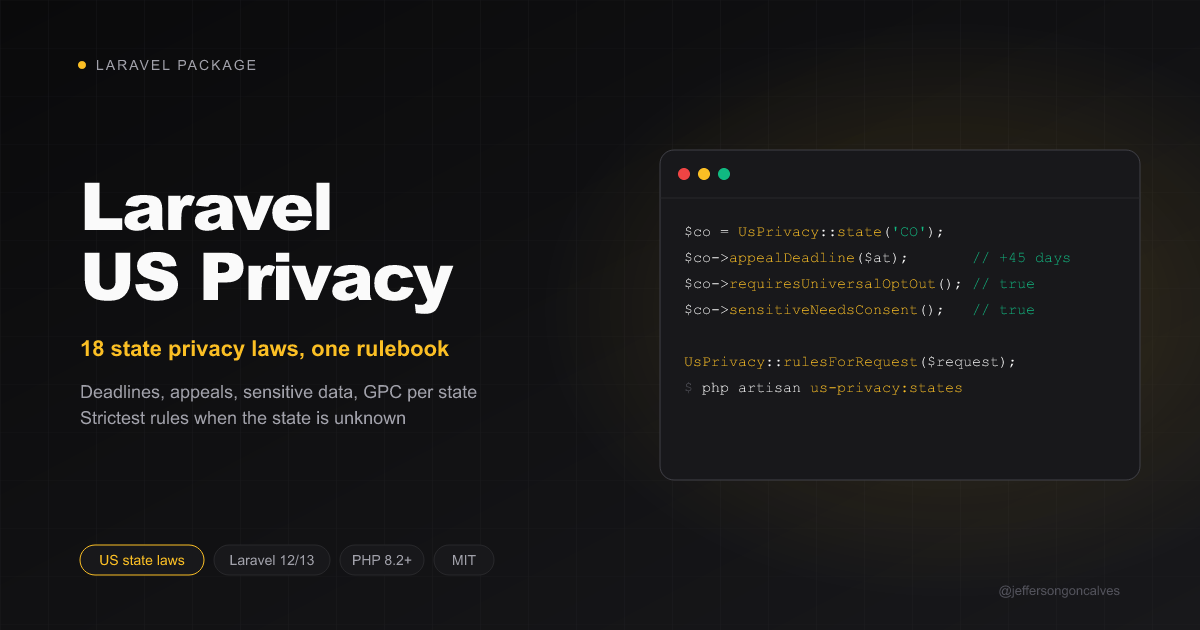


Core of a Laravel toolkit for the comprehensive privacy laws of the US states: Virginia, Colorado, Connecticut, Utah, Texas, Oregon, Montana, Iowa, Delaware, Nebraska, New Hampshire, New Jersey, Tennessee, Minnesota, Maryland, Indiana, Kentucky and Rhode Island. California has its own suite (laravel-ccpa).
- The rules of each state: when it took effect, who it covers, deadlines for requests and appeals, how sensitive data may be processed, when opt-out preference signals (Global Privacy Control) must be honored, whether data protection assessments are required, the rules for minors and the rights consumers have.
- The rules for each visitor: the law of their state, or the strictest combination when their state is unknown.
- The personal data inventory: which columns hold personal data, which are sensitive, and which you sell or use for targeted advertising or profiling. Export a consumer's data (access, portability) and deidentify it (deletion).
This package gives you tooling. It does not make you compliant on its own. The state rules below were compiled in November 2026 from the statutes and attorney general guidance; laws keep changing and the trackers disagree on some dates. Verify with counsel, and override anything in
config/us-privacy.php.
Installation
composer require jeffersongoncalves/laravel-us-privacy
php artisan vendor:publish --tag="us-privacy-config"
The state laws
php artisan us-privacy:states
php artisan us-privacy:states --consumers=40000 --sensitive   # which laws apply to you
| State | Response | Appeal | Sensitive data | Universal opt-out | Assessments | Minors (sale, targeted ads) |
|---|---|---|---|---|---|---|
| Virginia (2023-01-01) | 45 + 45 | 60 | opt-in | — | yes | under 13 |
| Colorado (2023-07-01) | 45 + 45 | 45 + 60 | opt-in | 2024-07-01 | yes | under 18 |
| Connecticut (2023-07-01) | 45 + 45 | 60 | opt-in | 2025-01-01 | yes | under 18 |
| Utah (2023-12-31) | 45 + 45 | — | notice + opt-out | — | no | under 13 |
| Texas (2024-07-01) | 45 + 45 | 60 | opt-in | 2025-01-01 | yes | under 13 |
| Oregon (2024-07-01) | 45 + 45 | 45 + 45 | opt-in | 2026-01-01 | yes | under 16 |
| Montana (2024-10-01) | 45 + 45 | 60 | opt-in | 2025-01-01 | yes | under 18 |
| Iowa (2025-01-01) | 90 + 45 | 60 | notice + opt-out | — | no | under 13 |
| Delaware (2025-01-01) | 45 + 45 | 60 | opt-in | 2026-01-01 | yes | under 18 |
| Nebraska (2025-01-01) | 45 + 45 | 60 | opt-in | 2025-01-01 | yes | under 13 |
| New Hampshire (2025-01-01) | 45 + 45 | 60 | opt-in | 2025-01-01 | yes | under 16 |
| New Jersey (2025-01-15) | 45 + 45 | 60 | opt-in | 2025-07-15 | yes | under 17 |
| Tennessee (2025-07-01) | 45 + 45 | 60 | opt-in | — | yes | under 13 |
| Minnesota (2025-07-31) | 45 + 45 | 45 + 60 | opt-in | 2025-07-31 | yes | under 16 |
| Maryland (2025-10-01) | 45 + 45 | 60 | strictly necessary only | 2025-10-01 | yes | under 18, prohibited |
| Indiana (2026-01-01) | 45 + 45 | 60 | opt-in | — | yes | under 13 |
| Kentucky (2026-01-01) | 45 + 45 | 60 | opt-in | — | yes | under 13 |
| Rhode Island (2026-01-01) | 45 + 45 | 60 | opt-in | — | yes | under 13 |
Days. Every state also requires parental consent for the data of a known child under 13 (COPPA). Extra rights: Oregon, Delaware, Minnesota and Maryland let consumers ask for the list of third parties their data went to; Minnesota lets them question the result of profiling. Iowa and Utah have no right to correct.
use JeffersonGoncalves\UsPrivacy\Facades\UsPrivacy;

$co = UsPrivacy::state('CO');
$co->requestDeadline($receivedAt);                 // +45 days
$co->requestDeadline($receivedAt, extended: true); // +90 days
$co->appealDeadline($appealedAt);                  // +45 days (null in Utah)
$co->sensitiveNeedsConsent();                      // true (false in Utah and Iowa)
$co->requiresUniversalOptOut();                    // true since 2024-07-01
$co->hasRight('opt_out_profiling');                // true
$co->applies(consumers: 120000);                   // true

UsPrivacy::inForce();     // laws in force today
UsPrivacy::strictest();   // shortest deadlines, opt-in, opt-out signals honored, every right
The rules for a visitor
$rules = UsPrivacy::rulesForRequest($request); // StateRules, or null when no US state law applies
The state comes from a location header holding the two-letter code, read only when the country header says US. With Cloudflare, turn on the Add visitor location headers managed transform (cf-ipcountry, cf-region-code; set other names with state_header and country_header), or bring your own:
UsPrivacy::resolveStateUsing(fn (Request $request) => $request->user()?->state);
A visitor from another country gets null. A US visitor whose state is unknown gets unknown_state: the strictest combination of the laws in force (default), or a state code. A state without a comprehensive law (California included: use laravel-ccpa) gets null.
Declaring personal data
use JeffersonGoncalves\UsPrivacy\Attributes\PersonalData;
use JeffersonGoncalves\UsPrivacy\Concerns\InteractsWithPersonalData;
use JeffersonGoncalves\UsPrivacy\Contracts\HasPersonalData;
use JeffersonGoncalves\UsPrivacy\Enums\{AnonymizeStrategy, DataCategory, SensitiveType};

#[PersonalData('name', purpose: 'Account identification', anonymize: AnonymizeStrategy::Mask)]
#[PersonalData('email', retention: '5 years', anonymize: AnonymizeStrategy::Hash, targetedAdvertising: true)]
#[PersonalData('health_notes', sensitiveType: SensitiveType::Health)]
#[PersonalData('purchase_history', sold: true, profiling: true)]
class User extends Authenticatable implements HasPersonalData
{
    use InteractsWithPersonalData;
}
sensitiveType(orcategory: DataCategory::Sensitive) marks sensitive data. The types cover the definitions of every state: racial or ethnic origin, religious beliefs, health, sex life or orientation, citizenship or immigration status, genetic and biometric data, data of a known child, precise geolocation, and those only some states list (national origin, transgender or nonbinary status, crime victim status, financial account, government identifier, union membership, neural data, consumer health data).sold,targetedAdvertisingandprofilingmark the processing consumers can opt out of in every state.
Register the model in config/us-privacy.php:
'models' => [
    App\Models\User::class,
],
Deidentify strategies
| Strategy | Result |
|---|---|
Nullify (default) |
null |
Hash |
HMAC-SHA256 keyed by US_PRIVACY_HASH_KEY (falls back to APP_KEY). It gives a stable pseudonym, so unique indexes keep working |
Mask |
Mary Smith → M********* |
Keep |
untouched, for data you must keep (an exception to deletion, such as a legal obligation) |
Encrypted casts ('encrypted') work as expected: the value is decrypted, then deidentified, then encrypted again.
Usage
UsPrivacy::inventory();            // one row per declared column, with sensitive_type, sold, targeted_advertising, profiling
$user->exportPersonalData();       // ['name' => ..., 'email' => ..., ...]
$user->anonymizePersonalData();    // applies each strategy and saves
anonymizePersonalData() fires JeffersonGoncalves\UsPrivacy\Events\PersonalDataAnonymized with the model and the columns it changed. Columns marked Keep are not in that list.
php artisan us-privacy:inventory          # table
php artisan us-privacy:inventory --json   # machine readable
k-anonymity
Deidentified data must not reasonably be linkable to a consumer. Before you share or publish a dataset as deidentified, check that nobody can be singled out by combining quasi-identifiers such as ZIP code, birth date and gender. A dataset is k-anonymous when every combination of those values is shared by at least k rows. It is l-diverse when each of those groups also holds at least l distinct sensitive values.
use JeffersonGoncalves\UsPrivacy\Generalize;

UsPrivacy::kAnonymity(Patient::class, [
    'zip' => Generalize::prefix(3),         // 94110 → 941
    'birth_date' => Generalize::date('Y'),  // 1990-03-01 → 1990
    'age' => Generalize::range(10),         // 34 → 30-39
    'gender',                               // as stored
], k: 5, sensitive: 'diagnosis');

// ['rows' => 1200, 'groups' => 87, 'k' => 3, 'rows_below_k' => 14, 'l' => 1]
php artisan us-privacy:k-anonymity "App\Models\Patient" zip birth_date --k=5 --sensitive=diagnosis
The command fails (exit code 1) when the data is below the target k, so it can run in CI or before a scheduled export.
Testing
composer test
Changelog
See CHANGELOG.
License
The MIT License (MIT). See License File.