laravel-feedback-board maintained by yousef-aman
Feedback Board
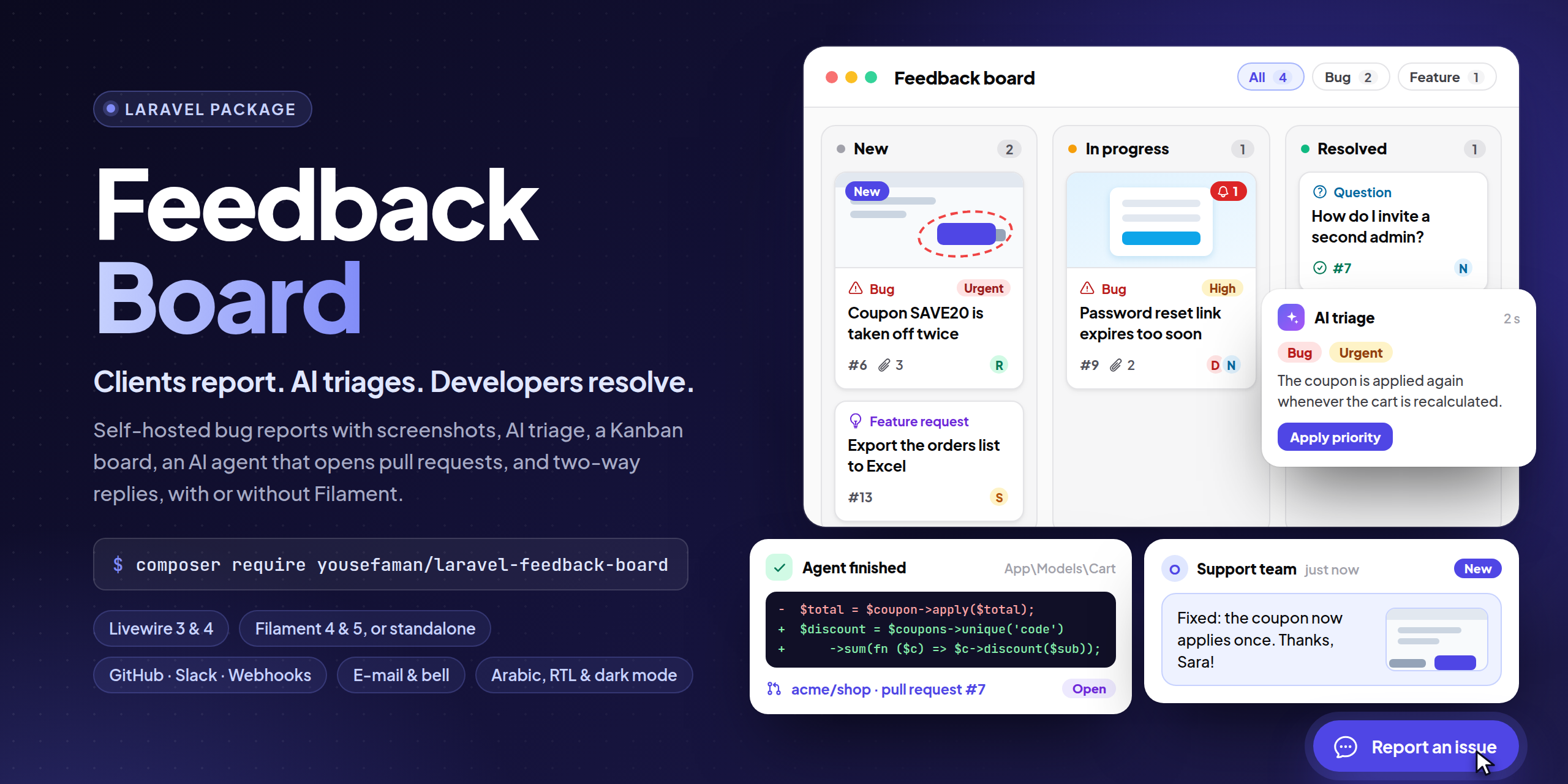
A self-hosted, embeddable feedback widget for Laravel applications. Clients submit bug reports and feature requests inside their own session — your data stays on your infrastructure, processed by your own runner.
Positioning
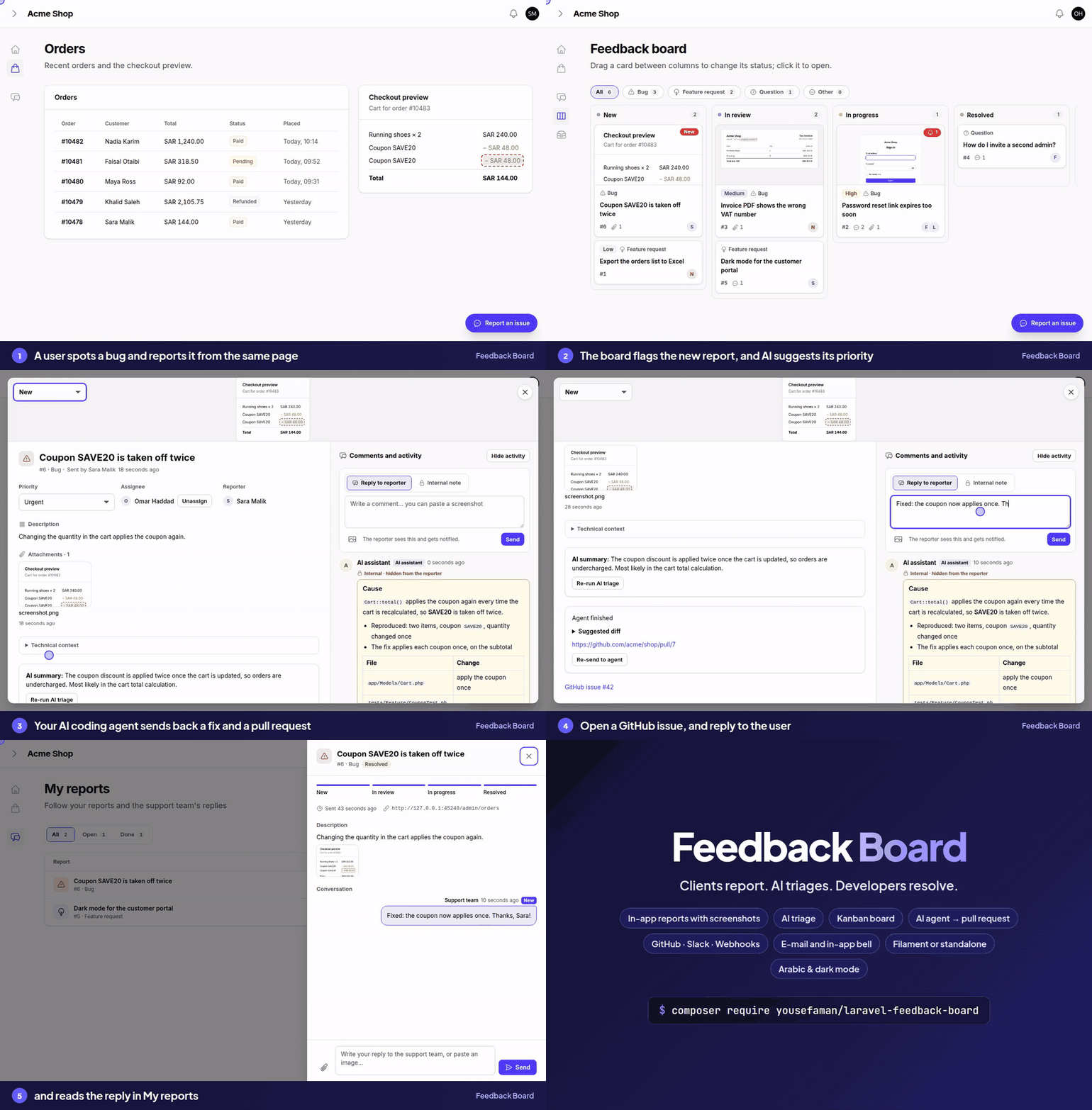
Feedback Board is self-hosted by design. Reports are captured inside the authenticated client's session (no third-party script, no external SaaS), stored in your own database, and processed through your own notification and AI pipelines. You own the data, the hosting, and the runner. Optional destination drivers (webhook, Slack, GitHub Issues), AI triage and an AI runner contract plug into the same pipeline. All of them are off until you enable them, and each one you enable sends data to the service it names (AI triage sends only a report's title and description to the model provider you choose — see AI Triage). A multi-tenant developer hub is planned — see the Roadmap.
Requirements
- PHP 8.2+ (8.3+ for Laravel 13)
- Laravel 12 or 13
- Livewire 3.8.3+ or 4.3.4+
- Filament 4 or 5 (optional). Without it, "My reports" and the developer board are pages of the package itself; see Link the pages
Installation
composer require yousef-aman/laravel-feedback-board
php artisan feedback-board:install
The install command publishes the config file and the migrations, offers to run the migrations, and prints the next steps. It is hidden from php artisan list, so type it as shown. Running it again is safe: an existing config/feedback-board.php is never overwritten and migrations are not published twice.
Manual installation
To publish by hand instead:
php artisan vendor:publish --tag=feedback-board-config
php artisan vendor:publish --tag=feedback-board-migrations
php artisan migrate
Publish views (optional, for customisation):
php artisan vendor:publish --tag=feedback-board-views
Publish translation files (optional, for customisation):
php artisan vendor:publish --tag=feedback-board-translations
Usage
1. Add the launcher to your layout
Add the <x-feedback-board::launcher/> Blade component to your authenticated layout (e.g. resources/views/layouts/app.blade.php):
<!DOCTYPE html>
<html lang="{{ str_replace('_', '-', app()->getLocale()) }}" dir="{{ __('feedback-board::feedback-board.dir') }}">
<head>
    ...
</head>
<body>
    ...

    {{ $slot }}

    <x-feedback-board::launcher />
</body>
</html>
The launcher renders a floating button in the bottom corner of the page (bottom-right in left-to-right locales, bottom-left in right-to-left ones) that opens the report form in a panel sliding in from the side; reporters can add screenshots by picking, dropping or pasting them. It renders for a signed-in user who may report. A user who may not report but has earlier reports gets a "My reports" link in its place, and a guest gets nothing, so a layout that also serves a login page needs no check of its own. See Choosing who can report, and Reporters on another guard when reporters sign in with a guard other than the default. Its styles load automatically — there is nothing to build, publish or link (see Styling & theming).
2. Tell the package who your developers are
Developers can triage, reply internally, assign and resolve reports. Register a resolver in your AppServiceProvider::boot():
use YousefAman\FeedbackBoard\Facades\FeedbackBoard;

public function boot(): void
{
    FeedbackBoard::resolveDevelopersUsing(fn ($user) => $user->hasRole('developer'));
}
Until you register a resolver, nobody is a developer.
Do not put a closure in
config/feedback-board.php. Laravel cannot cache closures, sophp artisan config:cache(andphp artisan optimize) fails on deploy. To configure access in the config file instead, pointauthorization.developer_resolverat a public static method:'developer_resolver' => [\App\Support\DeveloperCheck::class, 'handle'],A callback registered with
FeedbackBoard::resolveDevelopersUsing()takes precedence over the config value.
To check access in your own code, use FeedbackBoard::isDeveloper($user). It answers through the feedback-board.manage gate, so Gate::before() hooks (such as a super-admin rule) apply exactly as they do inside the package, and a guest (null) is never a developer.
3. Configure developer notifications
New reports, and replies from reporters, notify your developers. List their e-mail addresses in .env, separated by commas:
FEEDBACK_BOARD_DEVELOPER_EMAIL=dev@example.com,lead@example.com
or in the config file:
// config/feedback-board.php
'notifications' => [
    'developers' => ['dev@example.com', 'lead@example.com'],
],
Entries that Laravel's email validation rule rejects are skipped, with a warning in your log. Addresses such as dev@localhost, for a local mail catcher like Mailpit, are accepted.
To notify user models instead (for example, to also use Filament's in-app bell), register them in AppServiceProvider::boot(). This takes precedence over the config e-mails:
FeedbackBoard::notifyDevelopersUsing(fn () => \App\Models\User::where('is_admin', true)->get());
4. Notification channels
By default, notifications go out by mail only. To also store in-app (database) notifications:
php artisan make:notifications-table
php artisan migrate
Then add 'database' to notifications.channels in config/feedback-board.php. To show the bell in a Filament panel, also call ->databaseNotifications() on that panel. Recipients that are only e-mail addresses always receive mail only.
Notifications are sent, and destination deliveries (webhook, Slack, GitHub) queued, only after the report, reply or status change is saved. If sending or queueing fails (for example, the mail server is down, or a Slack outage on the sync queue), the failure is reported to your exception handler and the user's action is still kept.
Who is told what. A new report and a reporter's reply notify your developers; the reply's notification names the report (Reporter replied: {title}, with its number). A developer's or the AI's public reply, and the Resolved status, notify the reporter, and so does an open report moved to Closed or Declined; filing a finished report away (for example Resolved to Closed) sends nothing. Text a reporter wrote is escaped in e-mails (Markdown), the Filament bell (HTML) and Slack (<, > and &), and quoted as code in GitHub issues and comments; the webhook payload and the GitHub issue's title carry it unchanged. In the plain-text part of an e-mail, the escaping shows as a backslash before characters such as [ or *. The new-report database notification's feedback_title key holds the raw report title.
Links to the report. Each e-mail has a "View report" button, with the link written out under it, and so does each Filament bell entry. The reporter's button opens "My reports" on the report; a developer's opens the board on the report. Database payloads also carry the link as feedback_url.
The link goes to the first Filament panel, the default panel first, that has the plugin, no tenancy, and a guard the package recognises. For the reporter that is a panel whose guard's model is the reporter's, with "My reports" on; for a developer, a panel on a developer guard. A notified user must also be of that guard's model and, as a FilamentUser, allowed into the panel (canAccessPanel()). When no panel fits, the link goes to the standalone pages.
To build the links yourself, register a callback in AppServiceProvider::boot(). It gets the report, the audience ('reporter' or 'developer') and the notified model (null for an e-mail address). Only an absolute http/https URL is used; null, or anything else, leaves the button out, and a callback that throws is reported once and leaves it out:
use YousefAman\FeedbackBoard\Facades\FeedbackBoard;
use YousefAman\FeedbackBoard\Models\FeedbackItem;

FeedbackBoard::linkReportsUsing(fn (FeedbackItem $item, string $audience, ?object $recipient) => $audience === 'developer'
    ? route('admin.feedback', ['report' => $item->id])
    : route('portal.reports', ['report' => $item->id]));
5. Link the pages
"My reports" and the developer board are pages of the package itself, under your route_prefix and route_middleware. With the Filament plugin, panel users get the same pages inside the panel (see Filament Integration); the standalone pages stay, for everyone else and for e-mail links when no panel fits.
| Page | Path (default route_prefix) |
Route name | Who may open it |
|---|---|---|---|
| My reports | /feedback-board/feedback |
feedback-board.page |
every signed-in user who may report, or has reports |
| Feedback board | /feedback-board/feedback/board |
feedback-board.board.page |
developers; other users get 403 |
A guest is sent to your login page. Both pages take ?report={id} to open a report directly, which is how e-mail links open them. The report form links "My reports", but nothing links the board, so add it to your navigation for developers:
@can('feedback-board.manage')
    <a href="{{ route('feedback-board.board.page') }}">Feedback board</a>
@endcan
@can checks the user of your default guard. If your developers sign in with another guard (see Reporters on another guard), check the user the package sees instead:
@use('YousefAman\FeedbackBoard\Facades\FeedbackBoard')

@if (FeedbackBoard::isDeveloper(FeedbackBoard::user()))
    <a href="{{ route('feedback-board.board.page') }}">Feedback board</a>
@endif
Each page has a bar with your app's name (APP_NAME) and a "Back to the app" link to /. With the default theme setting the pages stay light; set FEEDBACK_BOARD_THEME=system to follow the operating system (see Styling & theming).
Choosing who can report
Every signed-in user may report until you say otherwise. Register a resolver in AppServiceProvider::boot():
FeedbackBoard::resolveReportersUsing(fn ($user) => $user->can_send_reports);
Or, in the config file, point authorization.reporter_resolver at a public static method (a closure there breaks config:cache):
'reporter_resolver' => [\App\Support\ReporterCheck::class, 'handle'],
A user who may not report keeps their earlier reports:
| May report | May not report, has reports | May not report, no reports | |
|---|---|---|---|
| Launcher | button that opens the report form | "My reports" link | nothing |
| "My reports" (panel page and standalone page) | yes, with "New report" | yes, without "New report" | hidden, and 403 |
| Sending a report | yes | 403 | 403 |
| Opening their reports and replying, with images | yes | yes | — |
FeedbackBoard::canReport($user) answers through the feedback-board.report gate, so Gate::before() hooks apply, and a guest is never a reporter. A Gate::before() hook that returns false for abilities it does not know therefore hides the launcher. A resolver returns a boolean; 1 and '1' also allow, and 0, '0' and null also deny. Any other value (another string such as 'N' or 'false', another number, an object or an array) denies and is reported to your exception handler once, and so does a resolver that throws; it never breaks the page. A count is not a boolean: return ->exists(), not ->count(). The same holds for the developer resolver.
Filament Integration
If you are using Filament, register the plugin in your Panel provider:
use YousefAman\FeedbackBoard\Filament\FeedbackBoardPlugin;

$panel->plugin(FeedbackBoardPlugin::make());
This adds three entries to the panel's navigation, in a translated Feedback group:
| Entry | Who sees it | Badge |
|---|---|---|
My reports (/admin/my-feedback) |
every panel user who may report, or has reports | reports with unread replies |
Feedback board (/admin/feedback-board-page) |
developers | open reports; red with the number of cards that have something new for you |
| All reports (the feedback items resource) | developers | — |
Reporters follow their reports and reply, with images, without leaving the panel; developers triage on the Kanban and work each report in a card dialog. To keep "My reports" out of a panel, such as an admin-only one, turn it off for that panel:
$panel->plugin(FeedbackBoardPlugin::make()->myReports(false));
Unread markers. On the developer board, a card shows a red bell with the number of comments by others (the reporter, a colleague, an internal note or the AI) since you last opened it, and a "New" label while it is an open report you have never opened and did not send. Opening the card clears both, and your own comments never count.
Only what happens after a developer's first board visit counts, so the first visit starts clean rather than lighting every old card. "New" applies to open reports only; a comment on a resolved report still rings the bell. The board's sidebar badge in the panel turns red with the number of cards that have something new and shows the open count when you hover it; it refreshes when the card dialog closes. The markers need the create_feedback_reads_table migration (see the upgrade notes in the changelog).
Colours. Inside a panel the package follows the panel's primary colour, in light and dark mode, with readable text on it (white, or the colour's darkest shade for a light primary such as amber). Your own --fb-accent properties still win.
Tenant panels. On a panel with ->tenant(...), the package's pages live under /{panel}/{tenant}/…, and reports are not scoped to a tenant: developers see every report whatever the tenant, while each reporter still sees only their own. Developer access is app-wide too, so a developer resolver that grants per-tenant admins lets them read the reports of every tenant. On a page of the panel that has no tenant (the profile page, tenant registration), the launcher links the standalone "My reports" page.
Reporters who use a Filament panel
If your reporters work inside a Filament panel rather than a custom layout, render the launcher through a render hook in that panel's provider:
use Filament\View\PanelsRenderHook;
use Illuminate\Support\Facades\Blade;

$panel->renderHook(
    PanelsRenderHook::BODY_END,
    fn (): string => Blade::render('<x-feedback-board::launcher />'),
);
The hook also runs on the panel's login page, where the launcher stays hidden until the user signs in. The form's "My reports" link opens the panel's "My reports" page when the panel shows it. If that panel signs users in with its own guard (->authGuard('client')), list the guard in auth.guards; without it, the package's own routes (images, the standalone pages) do not recognise those users. Until the guards are listed in auth.guards, there is no developer type check, so the developer resolver also receives that panel's users (for example a Client); a rule keyed on an id or an e-mail could match them. See Reporters on another guard.
Reporters on another guard
By default the package sees the user of the guard in use: inside a Filament panel, the panel's guard; elsewhere, the app's default guard. If your reporters sign in with a guard of their own, for example clients on a client panel with ->authGuard('client') while staff use web, list both guards and say which one your developers use:
// config/feedback-board.php
'auth' => [
    'guards' => ['web', 'client'],
    'developer_guards' => ['web'],
],
'route_middleware' => ['web', 'feedback-board.auth'],
- Developers. With more than one guard listed,
developer_guardsis required; without it nobody is a developer, and a warning is logged. Only a model of a developer guard's provider can be a developer, so a rule such asfn ($user) => $user->id === 1never matches a client, and your developer resolver never receives one. This holds even when your client model extends your staff model. Two exceptions: guards whose providers use the same model class cannot be told apart (same model, same person), and aGate::before()hook runs first and can still grant developer access. The package reads each guard's model from its user provider'smodelsetting, whatever the driver (eloquent, or a custom one such aseloquent-webauthn), as long as it names an Eloquent model class. A developer guard whose provider names none (thedatabasedriver, for example) has no developers, and a warning is logged. A listed client guard whose provider names none also logs a warning, because its users cannot be told apart from developers by type; thedatabasedriver is exempt. - Panels. Inside a panel only that panel's guard counts. A panel whose guard is not listed recognises nobody, and a warning is logged. A report is therefore never filed as the staff member who happens to be signed in in the same browser.
- Two sessions in one browser. On the package's own pages (the standalone "My reports" page and the board), the guard in use is tried first, normally the app default, then the list in order. Images open for whichever signed-in user may see them.
- A published config. If your published
config/feedback-board.phplists'auth'inroute_middleware, replace it with'feedback-board.auth'.'auth'checks the default guard only and refuses clients before the package sees them.feedback-board.authtakes no guard parameters (feedback-board.auth:clientdoes not restrict anything);auth.guardsdecides which guards count. Middleware that needs the signed-in user, such as'verified', goes after'feedback-board.auth'. - Not signed in on a listed guard. A user signed in only on a guard that is not listed is treated as a guest: no launcher, and the package's pages send them to your login page.
- The reporter model. Reports store their reporter as a polymorphic relation, so no migration is needed. To receive e-mail, the model needs Laravel's
Notifiabletrait and anemailattribute. If you enforce a morph map (Relation::enforceMorphMap()), add the model to it. Gate::before()hooks run for every user of every listed guard, before the package's own checks. A hook keyed on an id or an e-mail must also check the model type, or it will match a client with the same id.
i18n / RTL Support
The package ships with English (en) and Arabic (ar) translations. The Arabic locale sets dir to rtl. Pass the direction value to your layout's <html> tag as shown in the usage example above.
The package's e-mails follow the same direction: in Arabic their text runs and aligns right to left. A report title or reply inside an e-mail keeps its own direction, so an English reply in an Arabic e-mail, or the reverse, keeps its word order. They keep your app's mail layout and theme (mail.markdown.theme), and their greeting and sign-off come from the package's translations. They use the package's own Markdown template, feedback-board::mail.notification, so a customised vendor/notifications/email.blade.php does not change them; publish the package's views to customise that template.
Supported locales: en, ar. Add more by publishing translations (php artisan vendor:publish --tag=feedback-board-translations) and creating your own locale directory under lang/vendor/feedback-board/, for example lang/vendor/feedback-board/fr/feedback-board.php. Do not create resources/lang: once that directory exists, Laravel loads all of your app's translations from it instead of lang/.
Styling & theming
Every package screen — the launcher, the form, "My reports", the Kanban board, the slide-overs and the card dialog — ships with its own stylesheet. You do not build, publish or link anything: the first package component on a page adds a single cached <link rel="stylesheet"> to the page <head> (through Livewire's @assets), served by the package at /feedback-board/assets/stylesheet (under your route_prefix; the path has no .css extension so web-server rules for static files never intercept it). The styles only target the package's own fb-* classes and never touch your markup.
Dark mode. Set FEEDBACK_BOARD_THEME (config feedback-board.ui.theme):
| Value | Dark when |
|---|---|
class (default) |
an ancestor element has the class dark — Filament panels, Laravel's Livewire starter kits and Tailwind's class strategy. The package's own standalone pages have no host to set that class, so they stay light; use system to follow the operating system there. |
system |
the operating system prefers dark (prefers-color-scheme) |
light / dark |
never / always |
Brand colors and shape. Override these custom properties in your own CSS:
| Property | Default | Used for |
|---|---|---|
--fb-accent |
#4f46e5 |
primary buttons, the launcher, links (light theme), focus rings, the reporter-comment accent |
--fb-accent-hover |
#4338ca |
primary button hover |
--fb-accent-contrast |
#fff |
text on the accent color |
--fb-radius |
0.75rem |
panels, dialogs and slide-overs |
--fb-font |
your page font | font family |
--fb-z |
1000 (35 inside a Filament panel) |
stacking order of the launcher; dialogs and slide-overs sit 10 above it, the image preview 20 above it |
:root {
    --fb-accent: #0d9488;
    --fb-accent-hover: #0f766e;
}
The package never sets these properties itself (it only reads them with fallbacks), so your values win wherever you declare them — on :root, on .fb-scope, inside a dark-mode selector or a CSS @layer.
Inside a Filament panel the package follows the panel's dark mode and primary colour on its own (see Filament Integration); the properties above still override it.
Right-to-left. Layout direction follows the locale's dir (ar is right-to-left); the launcher, slide-overs, dialogs and spacing mirror automatically.
Content Security Policy. The stylesheet is a same-origin file, so style-src 'self' is enough; when you use Laravel's Vite CSP nonce (Vite::useCspNonce()), the <link> carries it too.
Responses Livewire does not post-process. The <link> is added to full HTML documents (a 200 text/html response containing </html>) and to Livewire updates. If you return a package component inside anything else — for example an HTML fragment fetched by your own JavaScript — link the stylesheet yourself:
<link rel="stylesheet" href="{{ \YousefAman\FeedbackBoard\Support\Ui::stylesheetUrl() }}">
Configuration Reference
Key configuration options in config/feedback-board.php:
| Key | Type | Description |
|---|---|---|
project |
string | Project name stamped on every new report (FEEDBACK_BOARD_PROJECT, default: 'default') |
auth.guards |
array|null | Guards whose users the package recognises (default: null, the guard in use) — see Reporters on another guard |
auth.developer_guards |
array|null | Guards whose users may be developers; required when auth.guards lists more than one guard |
authorization.developer_resolver |
callable|null | Public static method returning bool; prefer FeedbackBoard::resolveDevelopersUsing() (a closure here breaks config:cache) |
authorization.reporter_resolver |
callable|null | Public static method returning bool: who may send reports (default: null, every signed-in user); prefer FeedbackBoard::resolveReportersUsing() |
attachments.disk |
string | Storage disk for uploaded attachments (FEEDBACK_BOARD_DISK, default: 'local', private) |
attachments.directory |
string | Directory on that disk (default: 'feedback-board') |
attachments.max_kb |
int | Maximum upload size in kilobytes (default: 10240); the form shows the lower of this, PHP's upload_max_filesize and Livewire's upload limit |
attachments.allowed_mimes |
array | Allowed file extensions (default: images, pdf, txt, log) |
attachments.max_files |
int | Most files per report and per comment (default: 10) |
route_prefix |
string | URL prefix for package routes (default: 'feedback-board') |
route_middleware |
array | Middleware applied to package routes (default: ['web', 'feedback-board.auth']; feedback-board.auth is appended when missing) |
ui.theme |
string | Dark-mode strategy (FEEDBACK_BOARD_THEME): class (default), system, light or dark — see Styling & theming |
notifications.developers |
array|callable | Developer e-mail addresses (FEEDBACK_BOARD_DEVELOPER_EMAIL, comma-separated; invalid entries are skipped); for models prefer FeedbackBoard::notifyDevelopersUsing() |
notifications.channels |
array | Notification channels (default: ['mail']; add 'database' after make:notifications-table and migrate) |
destinations.default |
string | Kept for contract parity; the mail driver is a no-op (default: 'mail') |
destinations.enabled |
array | Automatic destination drivers, e.g. ['webhook', 'slack'] — empty by default. Do not add github here: its first issue is created by a developer, and later comments are posted without it (see Destinations) |
destinations.lock_store |
string|null | Cache store for the locks around GitHub delivery, delivery-failure records and the runner's PR link, and for the day of the developers' delivery-failure e-mail (FEEDBACK_DESTINATIONS_LOCK_STORE; null = app default). With several servers, use a shared store such as redis or database |
destinations.webhook / .slack / .github |
array | Per-driver URL, secret or token, and event list, plus Slack's message language (slack.locale) — see Destinations |
destinations.github.reporter_replies |
bool | Post reporters' replies on the GitHub issue, quoted as code (FEEDBACK_GITHUB_REPORTER_REPLIES, default: true); false posts only your team's and the AI's replies |
ingest.enabled |
bool | Enable the signed ingest endpoint (FEEDBACK_BOARD_INGEST_ENABLED, default: false) |
ingest.secret |
string|null | HMAC secret for ingest signature verification (FEEDBACK_BOARD_INGEST_SECRET) |
ingest.tolerance |
int | Timestamp drift tolerance in seconds (default: 300); rate limiting is handled by the route (throttle:60,1) |
ingest.nonce_store |
string|null | Cache store that remembers each signature, so it is accepted once (FEEDBACK_BOARD_INGEST_NONCE_STORE; null = app default). With several servers, use a shared store such as redis or database, or a request can be replayed on another server |
ai.enabled |
bool | Enable AI triage (FEEDBACK_BOARD_AI_ENABLED, default: false) — see AI Triage |
ai.default |
string | Triage driver: anthropic, gemini, openai or one added with FeedbackBoard::extendTriage() (FEEDBACK_BOARD_AI_DRIVER, default: 'anthropic') |
ai.queue |
string|null | Queue the triage jobs are pushed to (FEEDBACK_BOARD_AI_QUEUE; null or empty = the connection's default queue); make sure a worker listens on it, e.g. php artisan queue:work --queue=ai,default |
ai.lock_store |
string|null | Cache store for the per-item AI triage and runner lock (FEEDBACK_BOARD_AI_LOCK_STORE; null = app default). With several servers, use a shared store |
ai.max_input_chars |
int | Combined title and description budget sent to the model (default: 4000) |
ai.anthropic.* |
array | api_key (FEEDBACK_BOARD_ANTHROPIC_KEY), model (FEEDBACK_BOARD_ANTHROPIC_MODEL, default: 'claude-haiku-4-5'), timeout (30, seconds per attempt; the whole call, its retry included, stays within 40 seconds), max_tokens (1024) |
ai.gemini.* |
array | api_key (FEEDBACK_BOARD_GEMINI_KEY), model (FEEDBACK_BOARD_GEMINI_MODEL, default: 'gemini-3.5-flash-lite'), timeout (30), max_tokens (null = Gemini's own limit; thinking tokens count toward a cap) |
ai.openai.* |
array | api_key (FEEDBACK_BOARD_OPENAI_KEY), model (FEEDBACK_BOARD_OPENAI_MODEL, default: 'gpt-6-luna'), base_url (FEEDBACK_BOARD_OPENAI_BASE_URL, default: 'https://api.openai.com/v1'), reasoning_effort (FEEDBACK_BOARD_OPENAI_REASONING_EFFORT, default: 'none'; empty = not sent), timeout (30), max_tokens (null = the provider's own limit; sent as max_completion_tokens) |
runner.enabled |
bool | Enable the AI runner (FEEDBACK_BOARD_RUNNER_ENABLED, default: false) — see AI Runner Contract |
runner.endpoint / runner.secret |
string|null | Runner task-receive URL and HMAC secret (FEEDBACK_RUNNER_ENDPOINT, FEEDBACK_RUNNER_SECRET) |
runner.timeout / runner.connect_timeout |
int | Dispatch HTTP timeouts in seconds (defaults: 8, 4) |
runner.max_analysis_chars / runner.max_diff_chars |
int | Longest analysis and suggested diff accepted from the runner (defaults: 10000, 20000); a longer runner_result is rejected with a validation error, not truncated |
runner.callback_url |
string|null | Optional ingest URL placed in the task envelope (FEEDBACK_RUNNER_CALLBACK_URL) |
runner.stale_after |
int | Seconds without an update after which an in-flight task counts as stale (default: 1800; 0 = never). The card dialog says so and offers to re-send it, and the Filament action comes back; a late result from the replaced task gets 409 |
Attachments and images. Reports and comments can both carry files. Comments (from reporters and developers, internal notes included) take images only: JPEG, PNG, GIF and WebP, within allowed_mimes. Those images show inline and in a preview; every other file, SVG included, downloads. An internal note's images are served to developers only. Deleting a comment through its model ($comment->delete()) deletes its attachment rows and files. A delete that skips model events (->delete() on a query, DB::table() or raw SQL) still removes the rows through the foreign key, but leaves the files on the disk, like a deleted report. Deleting a whole report removes its rows through the database cascade, which runs no model events, so its files stay on the disk under attachments.directory/{report id}; delete that directory yourself.
Destinations (outbound)
Mirror feedback events to external systems. Configure under feedback-board.destinations.
Webhook (signed)
Set FEEDBACK_WEBHOOK_URL and FEEDBACK_WEBHOOK_SECRET, then add 'webhook' to
destinations.enabled. Each POST carries X-Feedback-Timestamp, X-Feedback-Signature
(HMAC-SHA256 over "{timestamp}.{rawBody}", bare hex — identical to the ingest contract),
X-Feedback-Event, and X-Feedback-Delivery. The payload is a curated whitelist; verify
the signature against the raw request body before trusting it. A reply that carries only images has an empty body ("").
Slack
Create an Incoming Webhook, set FEEDBACK_SLACK_WEBHOOK_URL, add 'slack' to
destinations.enabled. The webhook URL is a secret: the package never puts it in its exceptions, its error state or failed jobs. A connection error is reported as connection_error, and an unparsable URL as invalid_url; when Slack refuses the URL, the report says why (not_found_404 for a deleted webhook or an archived channel, auth_401 for a revoked one). Laravel's own HTTP client events still carry the request, so a tool that records them (Telescope, Nightwatch) can store the URL.
Each message names the event and the report's number, and shows the title, the start of the description, the type, priority, status (for a status change, the old and the new one) and reporter, with a link that opens the report on the developers' board (see FeedbackBoard::linkReportsUsing()). It is written in the app's language; FEEDBACK_SLACK_LOCALE (destinations.slack.locale) picks another, for example ar for an Arabic-speaking team on an app whose default is English.
GitHub Issues
Set FEEDBACK_GITHUB_TOKEN (a fine-grained PAT scoped to a single repo with
Issues: write — least privilege; the classic repo scope also works but grants far
broader access, avoid it) and FEEDBACK_GITHUB_REPO (owner/name). GitHub is not
added to destinations.enabled: the first issue is created by the developer's manual
"Send to GitHub" action; later replies and status changes auto-comment on it.
Each reply comment starts with its author's role, for example **Reporter** replied:; no person's name is sent. Once the issue exists, the card dialog and the All reports table link it.
A reporter's description and replies are posted as a code block, with an invisible word joiner after each / and @: GitHub makes no mention, reference or link of them, and a bot that looks for a /command or an @name in a comment finds none. A link copied from there carries the joiner too; the original text is on the report. A bot that acts on other text anywhere in a comment, such as !deploy, is not stopped; set destinations.github.reporter_replies to false (FEEDBACK_GITHUB_REPORTER_REPLIES) to post only your team's and the AI's replies. When the quoting alone would take a text past GitHub's 65,536-character limit, it is shortened, with a note; the full text stays in the app.
Set feedback-board.destinations.github.close_on_resolved to close the issue on resolve. Comments and closing always go to the repo where the issue was opened, even after FEEDBACK_GITHUB_REPO changes; if the token can no longer reach that repo, the delivery fails with not_found_404 or auth_401.
GitHub idempotency, delivery-failure records and the runner's PR link are guarded by a cache
lock from FEEDBACK_DESTINATIONS_LOCK_STORE (unset = your app's default cache store). The lock
must be shared by every worker that can deliver: file only coordinates workers on one server,
so with several servers use redis, memcached, dynamodb or database. The array store
is process-local (no cross-worker protection).
Delivery failures are isolated per destination. On a real queue, a failed delivery is retried
after 30 seconds, 2 minutes and 5 minutes, within 15 minutes; a GitHub rate-limit wait counts as
an attempt. A refusal that waiting cannot fix fails at once, without retries: HTTP 400, 401,
403, 404, 410 or 422, for example a revoked token or a wrong repository name. A GitHub rate
limit, which can also come as a 403 or a 422, is still retried. On the sync queue nothing is
retried. A delivery that still fails is recorded as a sanitized code in
external_refs.{driver}_last_error (never the raw error, URL, or token), and the next delivery
to that destination that gets through clears it. Developers see each failing destination in the
card dialog, with the reason, the event and how long ago. With Filament installed, developers
who are user models (FeedbackBoard::notifyDevelopersUsing()) also get a bell entry that names
the destination and the reason; it needs the notifications table. The other developers a new
report notifies (all of them without Filament, and those listed only by address with it) get an
e-mail instead, when notifications.channels has mail: at most one a day for each destination
and reason, so a new kind of failure is told the same day, and each failing report still shows
the failure on its card. When the e-mail reached nobody (the mail server is down, say), the next
failure tries again after 15 minutes. The day is counted in the cache store of
FEEDBACK_DESTINATIONS_LOCK_STORE, so clearing that cache can send a second e-mail the same
day. Internal notes are never forwarded to any destination.
Ingest endpoint (inbound)
Off by default (FEEDBACK_BOARD_INGEST_ENABLED). External systems, such as CI or your agent runner, POST JSON to /feedback-board/ingest (under your route_prefix), signed like the webhook: X-Feedback-Timestamp and X-Feedback-Signature, HMAC-SHA256 over "{timestamp}.{rawBody}" with FEEDBACK_BOARD_INGEST_SECRET. Each signature is accepted once; with several servers, point FEEDBACK_BOARD_INGEST_NONCE_STORE at a shared cache store so that holds across them.
action |
Fields | Effect |
|---|---|---|
comment |
item_id, body |
Adds a public AI comment; the reporter is notified |
status |
item_id, status |
Changes the report's status |
external_ref |
item_id, ref.key, ref.value |
Stores external_refs[key] = value |
runner_status, runner_result |
see docs/runner-contract.md |
Runner post-back |
ref.key must match ^[a-z][a-z0-9_.-]{0,63}$. github, pr_url and keys ending in _last_error are reserved for the package. ref.value is a string of at most 2048 characters.
Every answer has its real status: 200 {"ok":true}; 403 (missing or bad signature, stale timestamp, replay, a query string or a Content-Type that is not JSON); 404 (ingest disabled, unknown report); 409 (runner task mismatch); 422 (validation, with errors); 429 (more than 60 requests a minute); 503 (busy). The package's own answers have JSON bodies. Answers given before the route runs (maintenance mode's 503, 413 for an oversized body, 405) follow your app's error rendering: JSON when the sender asks for it with Accept: application/json, as post-back.sh does. A host rule set with shouldRenderJsonWhen() can still turn the body of a 404 for an unknown report, a 409, 429 or 503 into HTML; the status stays. Re-sign before retrying. String values are trimmed of leading and trailing whitespace.
AI Triage (Level A)
Optional, in-app AI triage that suggests a type and priority and a short summary for each new report. Suggestions are stored on the item; a developer reviews them and applies the type and priority one field at a time (the summary is shown, not applied) — the AI never changes a report's fields on its own.
Opt-in. Disabled by default. Enable it and choose a provider: anthropic, gemini or openai.
FEEDBACK_BOARD_AI_ENABLED=true
FEEDBACK_BOARD_AI_DRIVER=gemini          # or anthropic, openai

FEEDBACK_BOARD_GEMINI_KEY=...            # Google AI Studio
FEEDBACK_BOARD_ANTHROPIC_KEY=sk-ant-...
FEEDBACK_BOARD_OPENAI_KEY=sk-...

# optional:
FEEDBACK_BOARD_GEMINI_MODEL=gemini-3.5-flash-lite
FEEDBACK_BOARD_ANTHROPIC_MODEL=claude-haiku-4-5
FEEDBACK_BOARD_OPENAI_MODEL=gpt-6-luna
FEEDBACK_BOARD_AI_QUEUE=
FEEDBACK_BOARD_AI_LOCK_STORE=redis
Only the selected provider's key is needed, and an empty model setting uses the provider's default model. When AI is enabled but its provider is unconfigured (no API key, or an unknown driver name), triage stays inert — nothing is dispatched and the manual button returns 422.
Providers.
anthropic: the Messages API, with the triage as a forced tool call.gemini: the Gemini API'sgenerateContent, with the triage as JSON held to a schema. The key is sent in a header, never in the URL.openai: Chat Completions, with the triage as a forced function call.reasoning_effortis sent asnoneby default, because OpenAI's reasoning models call functions in Chat Completions only with reasoning off.FEEDBACK_BOARD_OPENAI_BASE_URLpoints it at any API that speaks the same protocol, such as DeepSeek, Mistral, OpenRouter or a local Ollama. SetFEEDBACK_BOARD_OPENAI_REASONING_EFFORT=(empty) for a provider or model that rejects that field. A provider that needs no key, such as a local Ollama, still needs a non-empty key setting: any placeholder will do.
Another provider. Register a driver in AppServiceProvider::boot() and select it by name. The
factory receives the settings under feedback-board.ai.{name}:
use YousefAman\FeedbackBoard\Facades\FeedbackBoard;

FeedbackBoard::extendTriage('mistral', fn (array $config) => new \App\Triage\MistralTriage($config));
The driver implements YousefAman\FeedbackBoard\Triage\Contracts\TriageDriver: it receives the title
and description and returns a TriageResult. If it also implements ChecksConfiguration, its
configured() decides whether triage runs; otherwise it counts as configured. A driver that fails
to build, or returns something other than a TriageDriver, turns triage off and is reported once
per request or worker. On failure, throw TriageException with a short code and keep keys out of
its message: http_429, http_5xx and connection_error are retried (three tries in all), and any
other code fails the triage at once. Any other exception fails it as unknown, without a retry and
without a report.
What leaves your app. Only the report's title and description are sent to
the model, jointly truncated to ai.max_input_chars (default 4000) to bound cost.
Reporter identity, email, attachments, and all internal fields are never sent. The
API key is read from the environment, never logged by the package, and never stored; failures
record only a short sanitized error code. Laravel's own HTTP client events still carry the request,
so a tool that records outgoing requests can store the key unless it hides the key's header
(Authorization for OpenAI, x-api-key for Anthropic, x-goog-api-key for Gemini); with
Telescope, add the last two through Telescope::hideRequestHeaders(). A summary is kept to 1,000
characters. Each provider has its own data terms; for example,
Google's terms for the Gemini API's free tier allow it to use what you send to improve its
products. Check your provider's terms before you send your users' reports to it.
Triggering. Triage runs automatically on new reports (after the creating transaction commits) and can be re-run from the "Triage with AI" button in the board's card dialog or the Filament resource.
Failures. The card says why a triage failed, for example that the provider refused the key or that the model name was not found. When a re-run fails, the card keeps the suggestion from the run before it and notes the failure above it.
Time. The call to the provider, its one retry included, ends within 40 seconds, and the triage
job has a 60-second timeout of its own, whatever --timeout the worker runs with. Keep the queue
connection's retry_after above 60 seconds (Laravel's default is 90), or a second worker may pick
the job up while it is still running.
Lock store. The per-item ai_state lock (also used by the AI runner) comes from
FEEDBACK_BOARD_AI_LOCK_STORE (unset = your app's default cache store). Like destinations, it
must be shared by every worker: file only coordinates workers on one server, so with several
servers use redis, memcached, dynamodb or database. The array store is
process-local (fine for a single process / tests, not for multi-worker deployments).
AI Runner Contract (Level B/C)
An optional, manual, opt-in extension that lets you connect an external AI coding agent (running in your own CI/CD or dev environment) to the Feedback Board.
How it works: A developer sends a report to the runner from the board's card dialog (or the
All reports resource in Filament). The package dispatches a signed HTTPS POST (the "task
envelope") to your configured runner.endpoint.
Your receiver verifies the HMAC, forwards the task to a CI job (e.g. GitHub Actions via
repository_dispatch), and the CI job runs your agent. Results are posted back to the
package's signed ingest endpoint and appear in the board for developer review.
Key runner config keys:
| Key | Env var | Description |
|---|---|---|
runner.enabled |
FEEDBACK_BOARD_RUNNER_ENABLED |
Enable runner dispatch (default: false, opt-in) |
runner.endpoint |
FEEDBACK_RUNNER_ENDPOINT |
HTTPS URL of your HMAC-verifying receiver |
runner.secret |
FEEDBACK_RUNNER_SECRET |
HMAC secret for outbound signing |
runner.callback_url |
FEEDBACK_RUNNER_CALLBACK_URL |
Optional explicit ingest URL placed in the task envelope |
ingest.enabled |
FEEDBACK_BOARD_INGEST_ENABLED |
Must be true to accept runner post-back results |
ingest.secret |
FEEDBACK_BOARD_INGEST_SECRET |
HMAC secret for verifying post-back |
Important: The runner runs in your CI/dev environment with scoped credentials — never in the production application context. The package never auto-merges; it stores a PR link and analysis for the developer to review. Secrets must never be written into a feedback item.
The analysis, like every comment by the AI assistant, is shown as Markdown: headings, lists, code, tables and links. Raw HTML is escaped, only http, https and mailto links stay links (opening in a new tab, without a referrer), and images show their alt text, so nothing is loaded from elsewhere. Comments people write stay plain text.
For the full protocol (envelope schema, HMAC formula, runner_status / runner_result
post-back actions, security requirements, and a worked end-to-end example) see
docs/runner-contract.md.
Reference implementations:
docs/examples/runner/receiver.example.php— minimal HMAC-verifying PHP receiverdocs/examples/runner/github-actions-feedback-runner.example.yml— GitHub Actions workflowdocs/examples/runner/post-back.sh— signed, retrying post-back sender the workflow calls
Roadmap
Shipped in 1.0: destination drivers (signed webhook, Slack, GitHub Issues), in-app AI triage (Level A) and the AI runner contract (Level B/C).
Planned for 1.1:
- Multi-tenant developer hub — one dashboard that aggregates reports from several client applications.
See CHANGELOG.md for release notes.
Security
Please report vulnerabilities privately, as the security policy describes, not in public issues.
License
MIT — see LICENSE.